Certification: great for preventing micromobility battery fires, but hard to verify
What micromobility equipment certification means, which standards matter, and why it’s so hard to verify compliance
As consumers, we don't often hear about product safety standards and equipment certification, but they play a huge role in ensuring the safety of the products and technologies we use every day. Organizations like UL Solutions develop safety standards that cover everything from lightbulbs to jet engines.
In North America, three key standards cover micromobility equipment: UL 2849 (e-bikes), UL 2272 (e-scooters, hoverboards, e-skateboards, and other personal e-mobility devices), and UL 2271 (lithium-ion batteries in personal e-mobility devices). Equipment tested and certified to these safety standards has been evaluated by an independent lab for electrical and fire safety.
When it comes to batteries, UL 2271-certified packs use high-quality cells from reputable manufacturers, include battery management systems (BMS) that detect and respond to dangerous conditions, and have passed rigorous thermal, electrical, and mechanical testing.
The problem? Verifying certification is surprisingly difficult.
Multiple standards
There are two widely used sets of safety standards: UL in North America and EN in Europe. Standard-setting bodies develop the standards, and different labs can test and certify products to those standards. Because labs vary in quality, lab accreditation is key. Certification to EN standards is more commonly found on equipment initially designed for the European market.
Tested ≠ Certified
Being certified to a standard is far more rigorous than being tested to a standard. Certification goes beyond one-off equipment testing and requires ongoing compliance through regular factory audits and production oversight.
Multiple labs
Labs fall into different tiers. OSHA-accredited Nationally Recognized Testing Laboratories (NRTLs) can certify equipment to UL standards. ISO/IEC 17065-accredited bodies can also certify equipment, while ISO/IEC 17025 labs are accredited only to test a product against a safety standard.
Hard-to-recognize marks
It’s not as simple as looking for “UL certified” on your equipment. Certified equipment bears the mark of the lab that certified it. That means a battery certified to UL 2271 might display the seal of another lab, such as Intertek, SGS, TÜV Rheinland, UL, or CSA, depending on who performed the certification. Only equipment certified by UL’s own lab will display a UL mark.
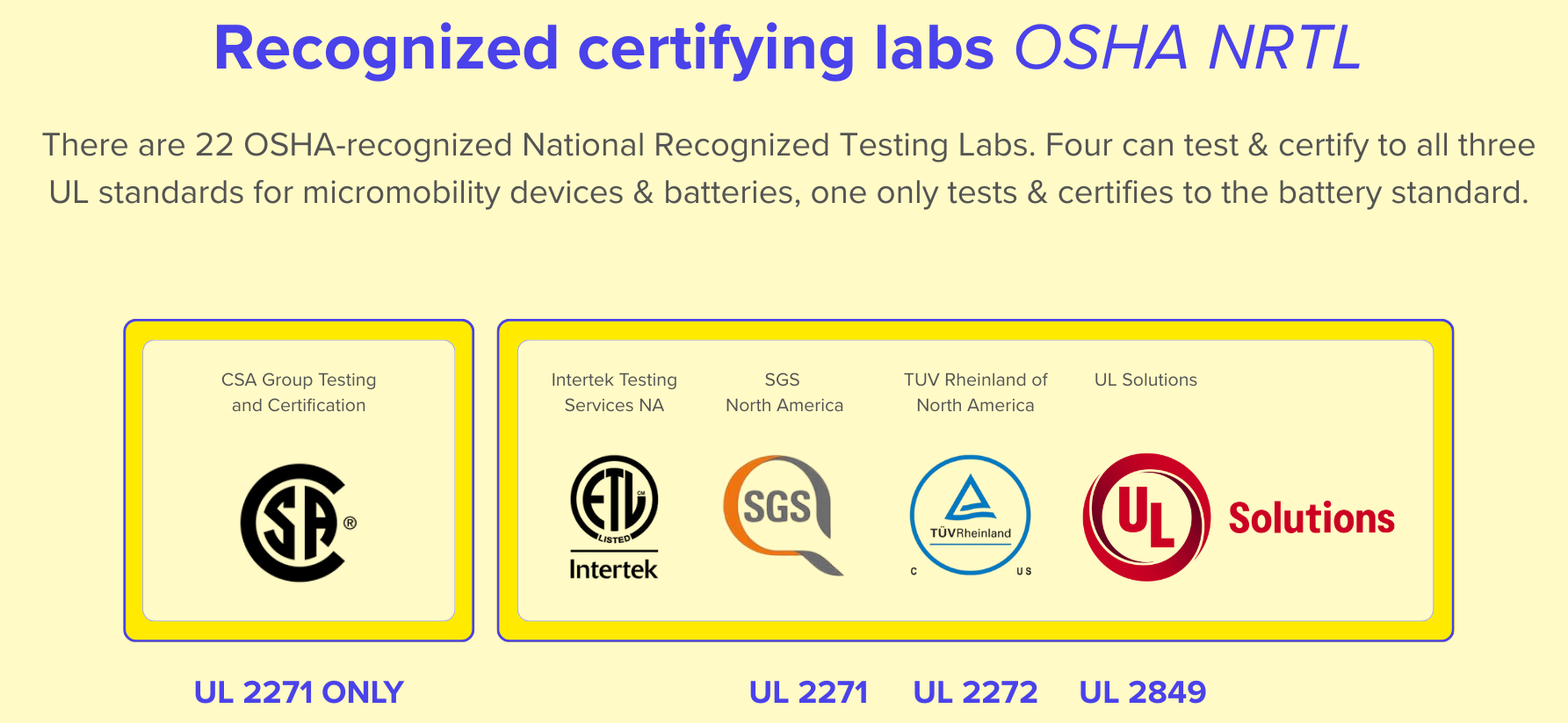
“UL certified” means certified by UL’s own lab. You’ll see the UL mark.
“Certified to UL standards” can be done by an accredited lab, like the NRTLs displayed above. You’ll see the mark of the certifying lab.
Beware of fake stickers
Counterfeit certification marks often appear on devices sold through online marketplaces. Most consumers won’t be able to differentiate a fake sticker from a real one.
Lack of US federal standards
While New York City and a few states (NY, CA, and IL) have laws prohibiting the sale (but not the use) of non-certified micromobility equipment, there is still no similar, binding national requirement. With porous state borders and direct-to-consumer purchasing, plenty of non-certified equipment is still being sold — even in these jurisdictions.
There's no single source of truth
Adding to the confusion, there isn’t a single database of testing and certification data across micromobility brands and labs. Some labs do have public databases — like UL’s Product iQ or TÜV Certipedia — but they’re designed for industry professionals, not everyday consumers, and they only include products certified by that specific body.
Electric Avenue is working on a solution to make this easier.
Product safety isn't top of mind for consumers
Most individual buyers are not in the habit of checking for certification marks on other lithium-ion battery-powered devices, like phones and laptops. The certification ecosystem wasn't designed with end consumers — or property owners — in mind.
If you're a property owner, where does that leave you?
It's vital to set a high bar for device and battery quality, but putting that into practice can be difficult given all this complexity.
Choosing your approach: simplicity vs. inclusivity
If you're a property owner setting a certification policy, you face a trade-off between ease of verification and equipment inclusivity.
Most restrictive approach (easiest to verify)
Under a more conservative approach, you could choose to accept only equipment certified to UL standards by OSHA-designated NRTLs, which limits acceptable marks to UL, Intertek, CSA, TÜV Rheinland, or SGS. This makes verification straightforward. But it excludes quality devices certified to EN standards or by ISO-accredited labs.
More permissive approach (harder to verify)
You can broaden the set of permitted equipment in a few different ways, but doing so makes verification more complex:
Expand the universe of certification labs you permit: Accept equipment certified to UL standards by NRTLs and ISO/IEC 17065-accredited labs. This maintains the certification requirement, but verification will be more challenging because there are many more labs and therefore more marks to look for.
Allow for equipment that has been tested but not certified: Accept products tested (but not necessarily certified) to UL standards. This sacrifices the ongoing manufacturing oversight that certification provides.
Accept EN standards: Accept products certified to European standards (EN 15194, EN 50604-1, EN 17128) by EU Notified Bodies and ISO/IEC accredited labs. Increases the complexity of verification significantly.
Allow any tested or certified device across major standards: Accept both UL and EN standards, with flexibility around which labs certified them. Maximizes device choice but requires sophisticated verification by device and property owners.
The right choice depends on your organization’s size, risk tolerance, and administrative capacity.
So what can property owners actually do now?
Instead of asking every resident, student, or employee to become a certification detective, a simpler approach is to steer them toward equipment you already know is certified.
Two approaches stand out:
1. Promote or partner with reputable equipment sellers and/or subscription providers
Whether it's a local bike shop or a company that offers all-inclusive e-micromobility devices on a monthly basis, choose partners that offer only high-quality, certified equipment and options for ongoing maintenance. Encourage or require people to buy or lease through these providers so individuals don’t need to navigate murky certification waters alone, and so that you know the equipment on your property is certified.
2. Partner with a shared micromobility provider.
These fleets are certified, professionally maintained, and charged offsite by trained staff, away from occupied buildings. Your community gets to enjoy the benefits of micromobility without the battery fire risk of personal batteries being brought indoors.
We'll share more about these approaches soon. Stay tuned!